
The Chemistry of Art: Mica Powders and Crystallization

Updated: Feb 24
Mica powders and crystallization play a critical role in how epoxy fine art develops texture, depth, and movement. These materials don’t simply add color—they influence how a piece forms, reacts, and ultimately reveals itself over time. Understanding this chemistry helps explain why no two epoxy artworks are ever truly the same.
In Martin Eichinger’s work, the chemistry is not hidden beneath the surface. It is part of the composition itself. The reactions between epoxy, pigments, and environmental conditions actively shape the final result, turning process into visual language.
Where traditional painting relies on controlled application, epoxy-based work introduces systems that continue to evolve long after the initial gesture.
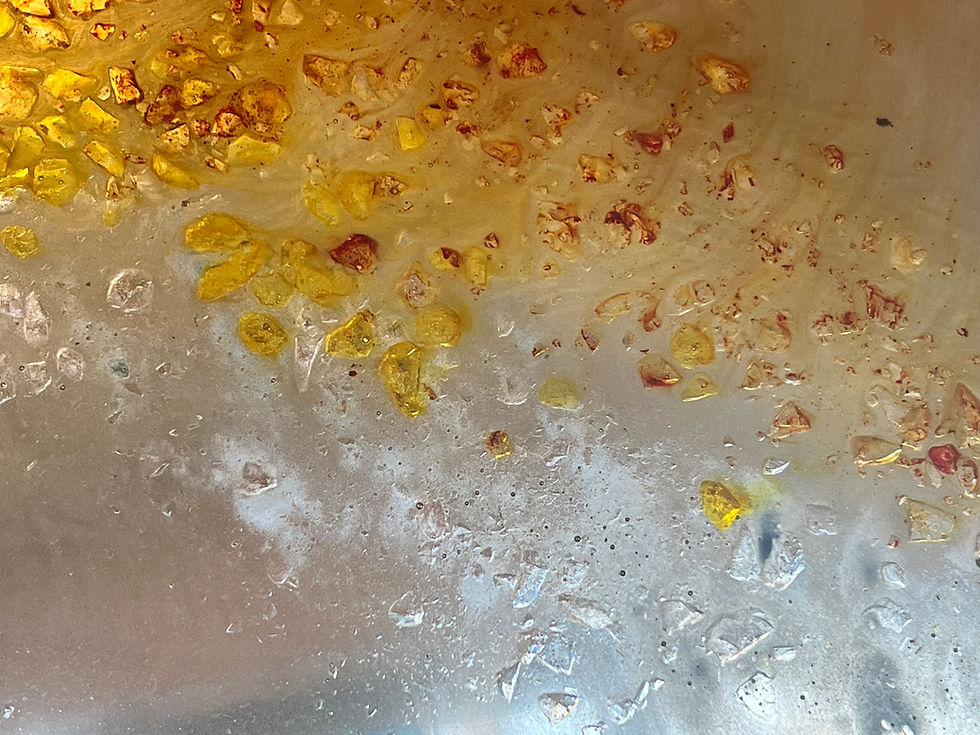
How Mica Powders Interact With Epoxy
Mica powders are mineral-based pigments known for their reflective, pearlescent qualities. When mixed into epoxy, they behave differently than standard paints or dyes.
Rather than dissolving evenly, mica particles suspend within the epoxy. As it moves, levels, and cures, these particles shift, separate, and settle in response to gravity and flow. The result is color that appears to drift, bloom, or fold into itself.
This interaction creates surfaces that feel dimensional rather than painted—color becomes something you look into, not just at.
Why Crystallization Creates Organic Movement
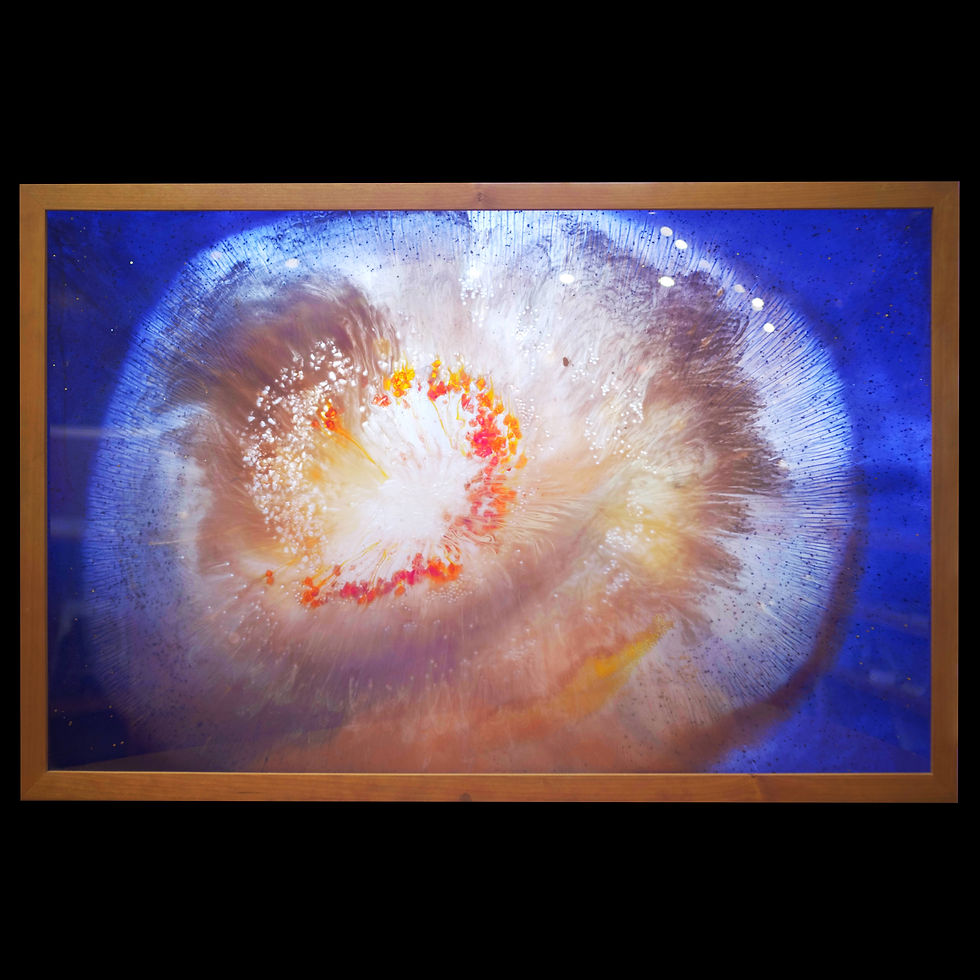
Crystallization occurs when certain chemical reactions within the epoxy cause pigments or additives to form visible structures. These formations are not drawn or placed by hand. They emerge.
In art, this introduces an element that feels organic and unrepeatable. Patterns form based on timing, temperature, and material ratios, producing shapes that resemble geological or cosmic processes rather than brushstrokes.
Once crystallization begins, control gives way to observation.
As Eichinger has noted, “At a certain point, you stop trying to direct the material and start paying attention to what it’s doing. That’s usually when the most interesting things happen.”
That shift—from command to collaboration—is central to the work.
What Chemistry Adds That Paint Cannot
Traditional paint sits on a surface. Chemistry operates within it.
Epoxy allows reactions to occur beneath the visible layer, creating internal movement that paint alone cannot replicate.
Color can appear to rise, sink, or fracture across depth rather than plane.
This internal activity gives epoxy-based art a sense of motion and time. The piece feels less like a frozen moment and more like a captured process.
For space-inspired or abstract work, this distinction matters. The materials don’t just depict complexity—they generate it.
When Process Becomes the Composition
In chemically driven art, the process is not something to be concealed. It is the source of meaning.
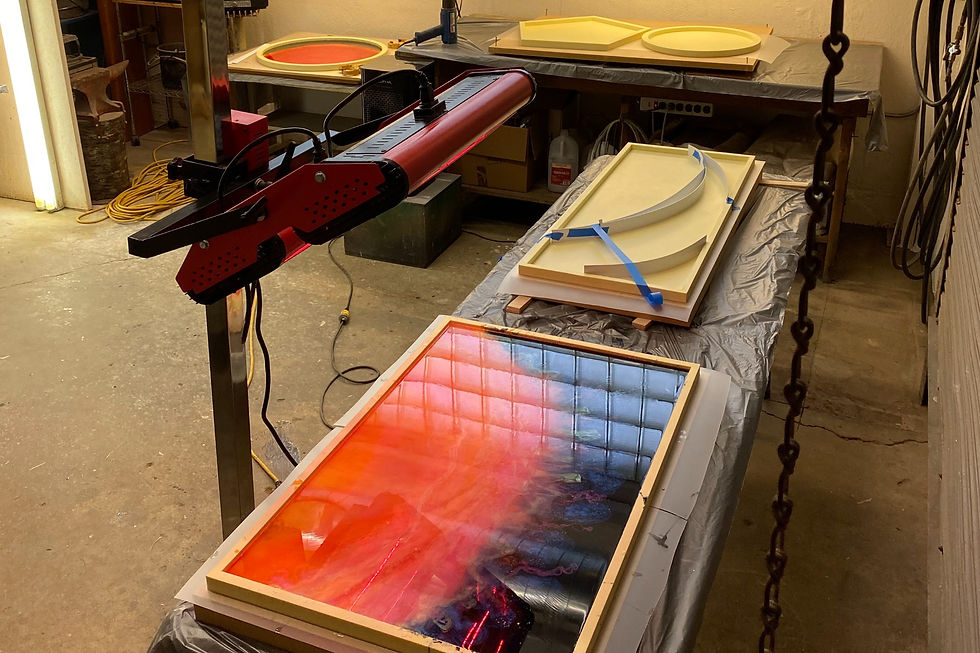
Variables such as heat, curing speed, and material interaction introduce risk, but also authenticity. Each piece records the conditions under which it was made. No two outcomes are identical, even when the same techniques are used.
This unpredictability is not a flaw. It’s a feature.
It reflects a worldview in which systems are respected, not forced—where discovery replaces replication.
Why Chemistry Matters in Fine Art
For collectors and viewers, understanding the chemistry behind epoxy fine art deepens the experience of the work.
Knowing that a surface was shaped by reaction rather than repetition encourages slower looking. Subtle variations, internal structures, and shifts in reflection become part of the reward.
The value isn’t just in what the piece shows, but in how it came to be.
Where to Find Epoxy Fine Art in Portland
For collectors interested in epoxy as fine art, experiencing the work in person is essential. The depth, crystallization, and interaction with light are difficult to fully appreciate on a screen.
In the Portland area, Eichinger Sculpture Studio and Art at the Geode Gallery offer the opportunity to view and collect epoxy artworks firsthand. The gallery presents epoxy works alongside traditional sculpture, allowing visitors to see how chemistry-driven pieces function within a fine art context.
Seeing the work in person provides clarity—not just about the material, but about what makes epoxy a compelling medium for contemporary art.
Comments